
Introduction
The rapid growth of urban populations has created new challenges for cities around the world. Governments must manage increasing demands for transportation, public safety, energy, healthcare, waste management, and digital services while maintaining sustainability and improving the quality of life for citizens. To address these challenges, many cities are adopting advanced technologies that support smarter and more efficient urban development.
One of the most important technologies driving this transformation is Edge Computing. Unlike traditional cloud computing, where data is processed in distant data centers, edge computing processes data closer to where it is generated. This approach reduces latency, improves response times, enhances security, and minimizes network congestion.
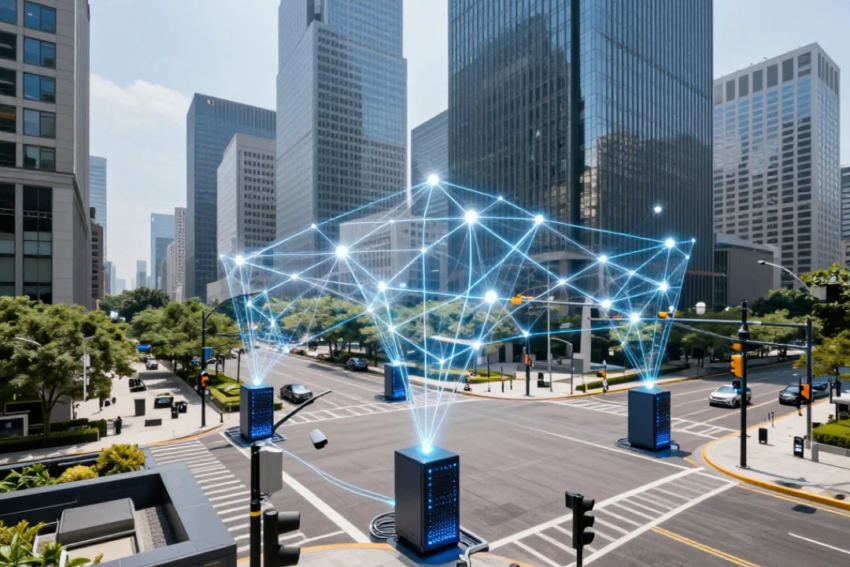
In smart cities, thousands of connected devices such as traffic cameras, environmental sensors, smart streetlights, and connected vehicles generate enormous amounts of data every second. Edge computing allows these devices to analyze and process information locally, enabling faster decision-making and more reliable city services.
This article explores the role of edge computing in smart cities, its key applications, benefits, challenges, and future opportunities.
What Is Edge Computing?
Edge computing is a distributed computing model that processes data near its source instead of sending all information to centralized cloud servers.
In traditional cloud computing, data travels long distances before it is processed. This can introduce delays that are unacceptable for applications requiring real-time responses.
Edge computing solves this problem by placing computing resources closer to users and connected devices. This allows information to be analyzed almost instantly, improving performance and reliability.
What Is a Smart City?
A smart city uses digital technologies, Internet of Things (IoT) devices, sensors, communication networks, and data analytics to improve public services and urban management.
The main goals of a smart city include:
- Improving transportation
- Enhancing public safety
- Reducing energy consumption
- Protecting the environment
- Optimizing city infrastructure
- Improving healthcare services
- Providing better experiences for citizens
Edge computing plays a vital role in making these systems faster, smarter, and more efficient.
Why Edge Computing Is Important for Smart Cities
Smart cities generate massive amounts of data every day.
Traffic cameras, parking sensors, surveillance systems, weather stations, connected vehicles, and utility meters continuously collect information.
Sending every piece of data to cloud servers would consume significant bandwidth and create delays.
Edge computing processes data locally, allowing city systems to respond immediately without waiting for cloud processing.
This makes critical services faster, more reliable, and more secure.
Applications of Edge Computing in Smart Cities
1. Intelligent Traffic Management
Traffic congestion is one of the biggest challenges facing modern cities.
Edge computing enables traffic cameras and sensors to analyze vehicle movement in real time.
The system can automatically:
- Adjust traffic signals
- Detect accidents
- Monitor congestion
- Prioritize emergency vehicles
- Improve traffic flow
Real-time processing helps reduce travel times and fuel consumption while improving road safety.
2. Smart Street Lighting
Street lighting consumes significant amounts of electricity.
Edge computing allows smart streetlights to automatically adjust brightness based on:
- Pedestrian activity
- Vehicle movement
- Weather conditions
- Time of day
This reduces energy consumption while maintaining public safety.
Smart lighting systems also detect equipment failures and report maintenance needs automatically.
3. Public Safety and Surveillance
Security cameras installed throughout cities generate enormous amounts of video data.
Instead of sending all video to cloud servers, edge computing analyzes footage locally.
AI-powered systems can identify:
- Suspicious activities
- Traffic violations
- Unauthorized access
- Emergency situations
Authorities receive instant alerts, enabling faster emergency response.
4. Smart Waste Management
Waste collection becomes more efficient with edge computing.
Smart waste bins contain sensors that monitor fill levels.
Edge devices analyze this data and notify waste management teams only when bins require collection.
Benefits include:
- Lower fuel costs
- Reduced traffic
- Cleaner streets
- Better resource management
5. Environmental Monitoring
Cities must continuously monitor environmental conditions.
Edge computing supports sensors that measure:
- Air quality
- Noise pollution
- Temperature
- Humidity
- Water quality
Real-time analysis allows city officials to respond quickly to environmental problems and improve public health.
6. Smart Energy Management
Modern cities consume large amounts of electricity.
Edge computing helps optimize energy distribution by monitoring:
- Electricity demand
- Grid performance
- Renewable energy production
- Equipment health
Utilities can balance energy supply more efficiently while reducing outages and operating costs.
7. Connected Public Transportation
Public transportation systems benefit significantly from edge computing.
AI-powered edge devices monitor buses, trains, and metro systems in real time.
These systems provide:
- Live vehicle tracking
- Arrival predictions
- Route optimization
- Passenger information
- Fleet management
Passengers receive more accurate travel information while operators improve service efficiency.
Benefits of Edge Computing in Smart Cities
Faster Decision-Making
Local data processing reduces delays, allowing city systems to react almost instantly.
This is essential for emergency services, transportation, and public safety.
Reduced Network Latency
Processing information closer to devices minimizes communication delays.
Applications requiring immediate responses perform much better.
Improved Data Security
Sensitive information can remain within local networks instead of constantly traveling to cloud servers.
This reduces cybersecurity risks and improves data privacy.
Lower Bandwidth Usage
Only important information is transmitted to cloud servers.
This reduces network congestion and communication costs.
Increased Reliability
Many edge devices continue operating even if internet connectivity is temporarily unavailable.
Critical city services remain functional during network disruptions.
Better Citizen Experience
Citizens benefit from:
- Shorter travel times
- Improved safety
- Reliable public services
- Cleaner environments
- Faster emergency responses
These improvements increase overall quality of life.
Challenges of Edge Computing in Smart Cities
Despite its many advantages, implementing edge computing presents several challenges.
High Infrastructure Costs
Building edge computing infrastructure requires investment in:
- Edge servers
- IoT devices
- Communication networks
- AI software
- Maintenance systems
Smaller municipalities may face financial limitations.
Cybersecurity Risks
Although edge computing improves privacy, connected devices remain potential targets for cyberattacks.
Strong encryption, authentication, and regular software updates are necessary to maintain security.
Device Management
A smart city may deploy thousands of connected devices.
Managing software updates, monitoring performance, and maintaining hardware requires advanced management systems.
Standardization
Many manufacturers produce different IoT devices using different communication protocols.
Ensuring compatibility between systems remains an ongoing challenge.
The Future of Edge Computing in Smart Cities
The future of smart cities will rely heavily on edge computing technologies.
Emerging innovations include:
- Autonomous public transportation
- AI-powered traffic systems
- Smart healthcare monitoring
- Intelligent emergency response
- Advanced environmental protection
- Digital public infrastructure
- Smart parking systems
The expansion of 5G networks will further improve edge computing performance by providing faster and more reliable connectivity.
Artificial Intelligence and edge computing will continue working together to create smarter, safer, and more sustainable urban environments.
Best Practices for Implementing Edge Computing
Cities planning to adopt edge computing should:
- Develop a long-term digital infrastructure strategy.
- Invest in secure and scalable edge devices.
- Strengthen cybersecurity policies.
- Integrate edge computing with cloud services where appropriate.
- Train technical staff to manage intelligent infrastructure.
- Continuously monitor system performance and reliability.
These best practices help ensure successful implementation while maximizing long-term benefits.
Conclusion
Edge computing is becoming a fundamental technology for the development of smart cities. By processing data closer to its source, it enables faster decision-making, improves public services, reduces network congestion, enhances cybersecurity, and supports sustainable urban growth.
From intelligent traffic management and smart street lighting to environmental monitoring and connected transportation, edge computing is transforming the way cities operate. It allows governments to deliver more efficient services while improving the daily lives of citizens.
Although challenges such as infrastructure costs, cybersecurity, and device management remain, the long-term advantages of edge computing far outweigh these obstacles. As technologies like Artificial Intelligence, the Internet of Things, and 5G continue to evolve, edge computing will play an even greater role in building the smart cities of the future.
Cities that invest in edge computing today will be better prepared to create safer, greener, and more connected urban environments for generations to come.