
Introduction
Industrial automation has become one of the most important drivers of productivity and innovation in modern manufacturing. Industries worldwide are adopting advanced technologies to improve efficiency, reduce operational costs, increase product quality, and ensure workplace safety. Among these technologies, Edge Computing has emerged as a game-changing solution that enables real-time data processing and faster decision-making.
Traditional cloud computing requires industrial machines and sensors to send data to remote servers for processing. While this approach works well for many applications, it can introduce delays that are unacceptable in industrial environments where decisions must be made instantly. Edge computing solves this problem by processing data close to where it is generated, allowing machines to respond immediately without relying on distant cloud data centers.
From smart factories and predictive maintenance to robotic systems and quality control, edge computing is transforming industrial automation by making production processes more intelligent, efficient, and reliable. This article explores how edge computing is revolutionizing industrial automation, its key applications, benefits, challenges, and future potential.
What Is Edge Computing?
Edge computing is a distributed computing model that processes data near its source instead of sending all information to centralized cloud servers.
In industrial environments, data is generated by machines, robots, sensors, production lines, and control systems. Instead of transmitting every piece of information to the cloud, edge devices analyze data locally and make decisions in real time.
This reduces latency, improves operational efficiency, and allows industries to maintain continuous production even during network disruptions.
Understanding Industrial Automation
Industrial automation refers to the use of machines, robotics, sensors, software, and control systems to perform manufacturing and industrial processes with minimal human intervention.
Automation helps industries:
- Increase production speed
- Improve product quality
- Reduce labor costs
- Minimize human error
- Enhance workplace safety
- Optimize resource utilization
When combined with edge computing, industrial automation becomes even more intelligent and responsive.
Why Edge Computing Matters in Industrial Automation
Modern factories generate enormous amounts of operational data every second.
Sensors continuously monitor:
- Machine performance
- Temperature
- Pressure
- Vibration
- Energy consumption
- Production speed
Sending all this information to cloud servers creates unnecessary delays and consumes significant bandwidth.
Edge computing processes data locally, allowing machines to react immediately to changing conditions without waiting for cloud responses.
This is essential for applications where even milliseconds matter.
Applications of Edge Computing in Industrial Automation
1. Smart Manufacturing
Edge computing enables smart factories to process production data in real time.
Manufacturing systems continuously analyze machine performance and production quality while making immediate adjustments when necessary.
Benefits include:
- Higher productivity
- Reduced downtime
- Better product quality
- Faster production cycles
Smart manufacturing allows factories to operate more efficiently while reducing operating costs.
2. Predictive Maintenance
Unexpected equipment failures can cause expensive production delays.
Edge computing continuously monitors machine health using data collected from sensors.
The system analyzes:
- Motor vibrations
- Equipment temperature
- Pressure levels
- Power consumption
- Mechanical performance
If abnormal behavior is detected, maintenance teams receive alerts before equipment fails.
Predictive maintenance reduces downtime, extends equipment life, and lowers maintenance costs.
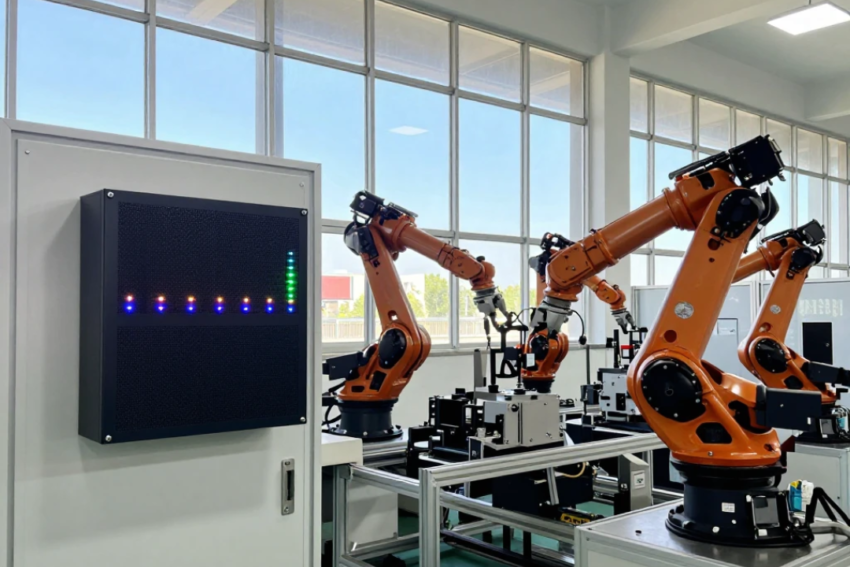
3. Industrial Robotics
Modern factories increasingly rely on robotic systems for repetitive manufacturing tasks.
Edge computing enables robots to process sensor data instantly, allowing them to:
- Adjust movements
- Detect obstacles
- Improve precision
- Coordinate with other robots
- Respond to production changes
Real-time processing improves both speed and accuracy.
4. Quality Control
Maintaining consistent product quality is essential for customer satisfaction.
Edge computing combined with AI-powered cameras inspects products during manufacturing.
The system identifies:
- Surface defects
- Incorrect dimensions
- Assembly errors
- Packaging issues
- Product inconsistencies
Defective products can be removed immediately without interrupting production.
5. Industrial IoT (IIoT)
The Industrial Internet of Things connects machines, sensors, and equipment across manufacturing facilities.
Edge computing processes IIoT data locally, reducing communication delays while improving operational efficiency.
Industries gain better visibility into equipment performance and production status.
6. Energy Management
Manufacturing facilities consume large amounts of electricity.
Edge computing monitors energy usage in real time and identifies opportunities to reduce consumption.
Factories can optimize:
- Power distribution
- Equipment scheduling
- Cooling systems
- Lighting
- Machine operation
Lower energy consumption reduces operating costs while supporting sustainability goals.
7. Workplace Safety
Industrial environments often involve hazardous conditions.
Edge computing improves worker safety by monitoring:
- Gas leaks
- Equipment failures
- Restricted areas
- Worker movement
- Emergency situations
Real-time alerts help prevent accidents before they occur.
Benefits of Edge Computing in Industrial Automation
Faster Decision-Making
Local data processing enables machines to respond immediately to operational changes.
This improves manufacturing efficiency and production quality.
Reduced Latency
Edge computing minimizes communication delays, making it ideal for time-sensitive industrial applications.
Lower Bandwidth Usage
Only essential information is transmitted to cloud servers.
This reduces network congestion and communication costs.
Improved Reliability
Factories can continue operating even if internet connectivity is temporarily interrupted.
Critical production systems remain functional.
Enhanced Security
Sensitive production data remains within local industrial networks, reducing cybersecurity risks.
Increased Productivity
Automation combined with edge computing improves production speed while reducing equipment downtime.
Challenges of Edge Computing in Industrial Automation
Despite its advantages, implementing edge computing presents several challenges.
High Initial Investment
Industries must invest in:
- Edge servers
- Industrial sensors
- Network infrastructure
- AI software
- Employee training
Smaller manufacturers may face budget limitations.
Cybersecurity
Connected industrial systems are potential targets for cyberattacks.
Strong cybersecurity measures, encryption, and continuous monitoring are essential.
System Integration
Many factories still use older manufacturing equipment.
Integrating legacy systems with modern edge computing platforms can be complex.
Skilled Workforce
Organizations need employees with expertise in edge computing, networking, AI, and industrial automation.
Training programs are essential for successful implementation.
The Future of Edge Computing in Industrial Automation
The future of industrial automation will increasingly rely on edge computing technologies.
Emerging innovations include:
- Fully autonomous factories
- AI-powered production systems
- Digital twins
- Advanced robotics
- Smart warehouses
- Real-time supply chain optimization
- Intelligent maintenance systems
The expansion of 5G networks will further enhance edge computing by providing ultra-fast communication between industrial devices.
Artificial Intelligence and edge computing together will create highly intelligent manufacturing environments capable of making complex decisions without human intervention.
Best Practices for Implementing Edge Computing
Industries planning to adopt edge computing should:
- Develop a clear digital transformation strategy.
- Invest in secure and scalable edge infrastructure.
- Strengthen cybersecurity policies.
- Integrate edge computing with cloud platforms.
- Train employees on new technologies.
- Continuously monitor system performance and security.
Following these best practices helps organizations maximize the benefits of edge computing while minimizing implementation risks.
Conclusion
Edge computing is transforming industrial automation by enabling faster data processing, real-time decision-making, and intelligent manufacturing operations. From predictive maintenance and industrial robotics to quality control and energy management, edge computing helps industries improve efficiency, reduce costs, enhance safety, and maintain consistent product quality.
Although challenges such as infrastructure investment, cybersecurity, and workforce training remain, the long-term benefits of edge computing make it an essential technology for modern manufacturing. As Industrial IoT, Artificial Intelligence, robotics, and 5G continue to evolve, edge computing will become even more important in building smart factories and highly automated production systems.
Businesses that embrace edge computing today will gain a competitive advantage through increased productivity, improved operational efficiency, reduced downtime, and greater flexibility. Edge computing is not just improving industrial automation—it is shaping the future of intelligent manufacturing.